Take-home sales at the grocers reached a record £13.8 billion in the four weeks to 28 December 2025, up 3.8% year on year, according to new data from Worldpanel by Numerator. Grocery inflation eased slightly to 4.3%, offering modest relief to shoppers, who on average spent £476 at the supermarkets during the festive month – an additional £15 in comparison to December 2024.
As anticipated, with Christmas falling on a Thursday, Monday 22nd December was the busiest day for grocery sales. Yet shoppers made the most trips the following day, on Tuesday 23rd December, spending less but topping up on last-minute festive essentials.
Premium own label continued its upward march, with growth of 9% taking a significant 7.5% of overall sales, up from 7.1% last year. For the first time, supermarkets’ premium own label lines exceeded the £1 billion milestone in December, with these products finding their way into 92% of shoppers’ baskets. The highest spend was seen in fresh meat (£115 million in sales) and chilled snacks like finger food, dips, and antipasti (£80 million in sales).
While traditional, large format supermarkets accounted for 60.3% of sales over the four-week period, discounter retailers saw their biggest ever share of sales at Christmas, reaching a total of 16.8%. More British households turned to online channels for their festive shopping too, with online retail growing at 7.5% and reaching a total share of 12.2%.
Spending on promotions and deals reached 33.3%, up from 32% last year, the highest proportion of overall sales since December 2019, before the onset of the pandemic. Households spent an additional £36 million on discounted fresh vegetables compared with last Christmas, capitalising on widespread retailer offers.
Fraser McKevitt, head of retail and consumer insight at Worldpanel by Numerator, said: “Easing inflation helped to take the edge off the cost of Christmas this year, giving households a little more room to spend. It was a Christmas of smart savings and considered choices – almost every household bought into supermarkets’ premium ranges, while price remained front of mind. Discounters enjoyed their biggest-ever Christmas share, and shoppers leaned on their loyalty cards to get the best deals.”
Seasonal tubs, tradition and temperance
With chocolate’s exposure to inflationary cocoa prices, the typical price of seasonal chocolate tubs rose above £5 for the first time. Despite average pack sizes shrinking by 5% down to 551g, these festive favourites remain a tradition for almost a quarter of British shoppers. Sales rose by 19% in the four weeks to Christmas, as nearly one million more shoppers bought into the category.
A look at buying habits across the regions saw Scottish households most likely to buy seasonal chocolate tubs, sweets and sparkling wine, while gravy granules were most popular in the North of England, and shoppers in the South kept it traditional, favouring fortified wines, mince pies and Christmas puddings.
Alcoholic drinks for December’s festive moments were purchased by three quarters of British shoppers, while the low and no-alcohol category, saw a 14% rise in spend, bought by 2.7 million households. Despite this, the proportion of households choosing no- and low-alcohol drinks edged down slightly, from 9.6% to 9.5%.
McKevitt added: “Over the last five years, the number of households cutting alcohol out of their shopping basket altogether has steadily increased. Alongside this, we’ve seen a rapid rise in sales of low- and no-alcohol alternatives.
“However, the slight dip in the numbers of buyers in December may signal that the category is beginning to mature, while the rise in sales shows that converted households are doubling down on their favourite low- and no- alcohol tipples.
“What’s clear, is that as consumers, we’re open to more variance during those traditional, festive moments – whether it’s switching the Bucks Fizz for Kombucha or enjoying a classic cocktail alongside a more health-focused option, consumers are finding enjoyment in more choice.”
Ocado and Lidl lead in December market share gains
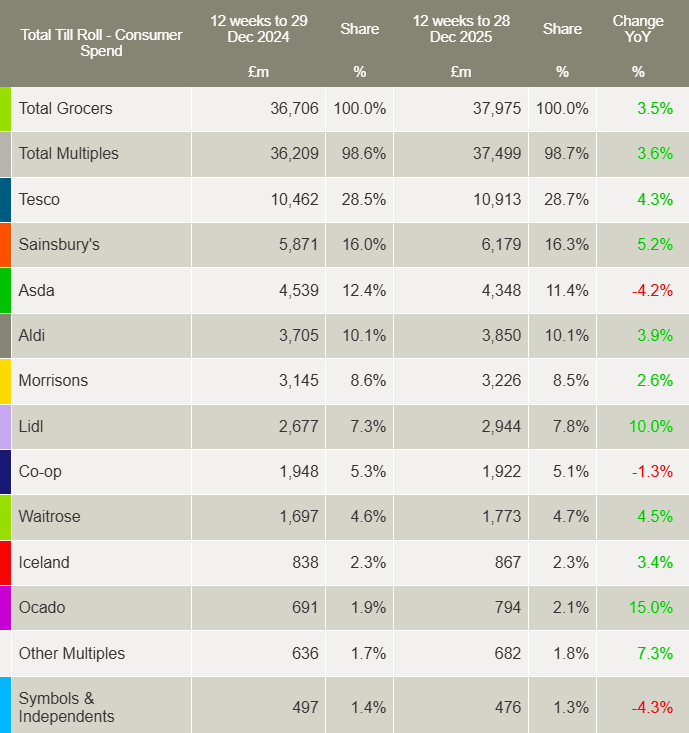
Ocado was once again the fastest growing grocer, with sales increasing by 15% over the 12 weeks to 28 December 2025 compared with the same period a year ago. The online specialist does remain a relatively small retailer, now accounting for 2.1% of the market, up from 1.9% last year.
Lidl made the greatest gain in market share among the supermarkets, adding 0.5 percentage points to claim 7.8% of the market – a record for the discounter over the festive period. Sales growth of 10% meant Lidl was the fastest growing bricks and mortar retailer, following a 5.8% footfall increase.
Sainsbury’s market share in December reached 16.3%, up from 16.0% last year. With growth of 5.2%, it maintains the run of exceeding 5% growth every month since June 2025.
Tesco sales were 4.3% higher than in 2024, with its share rising by 0.2 percentage points to 28.7%, the greatest proportion of the market since March 2015. Also growing ahead of the market was Aldi, with sales up 3.9%, and Waitrose up by 4.5%. Aldi share remained at 10.1% while Waitrose moved up to 4.7% from 4.6% last year, increasing the average amount spent on a trip by 6.5%, outpacing gains in competitors. Beyond the supermarkets, grocery sales at M&S were 7.2% higher over the 12-week period.
Asda now claims 11.4% of market share, while Iceland holds 2.3%. Convenience retailer Co-op has a 5.1% share of take-home sales.