 Effective click-and-collect requires more than a collection point, it demands careful reworking of store operations, workflows, and space planning to deliver speed, accuracy, and ease for both shoppers and store teams.
Shoppers now expect click-and-collect as standard. The appeal is clear: customers can order online and collect in store at a time that suits them, often avoiding delivery fees and delays. This expectation is now shaping the way retailers configure their stores, as speed, accuracy and convenience have to be balanced against footfall, space and staff workflows. For many retailers, working with suppliers such as AJ Products can help streamline store redesign or expansion to support these customer journeys. The company supplies shelving, storage, packing benches and ergonomic trolleys that can help with space planning for click-and-collect, whether in a single store or across several sites.
Balancing space for collections and sales
Allocating physical space for click-and-collect means more than just adding a table near the entrance. The challenge is to provide easy access for collection without reducing the area available for merchandising or customer browsing.
For retailers rolling out click-and-collect at scale, some stores use front-of-house counters for quick handovers, while others invest in secure lockers or set up backroom handover points. The best approach depends on store layout, order volume and customer profile. Analysing collection patterns and customer feedback can help retailers choose between dedicated zones, flexible pop-up counters or multi-use areas that switch between regular checkout and collection as needed.
Designing a workflow for speed and accuracy
Successful click-and-collect relies on a clear workflow that minimises steps and reduces the chance of errors. Each order typically moves through stages: receiving inbound goods, organising them for storage, picking items for each customer, checking orders for completeness, bagging, staging ready for pickup and the final handover.
Organising these stages along a logical, physical path prevents backtracking and confusion. Well-planned layouts improve staff productivity and reduce mistakes, especially during busy trading hours. Staging areas near the collection point reduce travel time and keep collection quick, minimising waiting for both customers and staff.
Practical storage solutions
The choice of storage has a direct effect on pick speed and order accuracy. High-density shelving, customisable bin systems and clear labelling help staff find items quickly, avoid time-wasting searches and reduce mis-picks. For items with high turnover or seasonal peaks, adjustable slotting and colour-coded locations simplify replenishment and picking.
Flexible racking allows storage to be scaled up or down as order volumes change, while dedicated ‘hot pick’ zones keep the fastest-moving products within easy reach. As demand changes, regular reviews of the storage setup help it keep pace.
 Fixtures and equipment for efficient handling
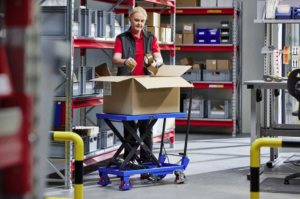 Fixtures and equipment for efficient handling
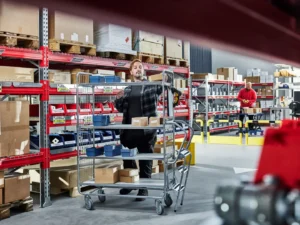
Designing for efficiency means investing in suitable equipment. Picking trolleys with divided compartments help staff assemble multiple orders in one trip. Packing benches and barcode scanning stations support accurate order checking and secure bagging.
Trolleys with ergonomic handles and safe stacking features help prevent staff injuries, while clearly defined pathways reduce the risk of collisions or congestion on the shop floor. The right workstations and equipment help teams work quickly without compromising safety or accuracy.
Managing order peaks and exceptions
High order volumes at Christmas and other busy periods, missed collections and customers returning items can easily disrupt daily operations. Clear processes are needed for handling partial orders, substitutions and returns without affecting the flow of new collections.
Temporary staging zones and defined spaces for exceptions can absorb overflow during busy periods, while reliable checking systems help avoid confusion between orders. A flexible setup means unexpected pressures, such as high-volume promotions or product recalls, don’t disrupt routine tasks.
Securing the handover and enhancing customer experience
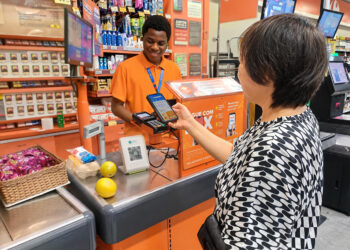
At the collection point, making sure orders are handed over correctly is key to preventing losses or mix-ups. Many retailers use simple verification such as order numbers, ID checks or barcode scans to ensure accuracy and security.
Physical barriers or managed queues help maintain an orderly flow, and discreet but secure staging areas give customers confidence that their purchases are safe. Planning for both pace and privacy at the handover makes collection smoother and leaves customers with a better impression.
Continuous improvement and measurement
Adapting for click-and-collect is an ongoing process. Tracking measures such as average pick time, customer wait times, error rates and space utilisation helps identify weak points and opportunities for improvement.
Staff feedback adds to this, making it easier to spot inefficiencies or workflow frustrations. Regular reviews of the store’s setup allow layouts, equipment and processes to be adjusted as customer behaviour and order volumes change. Stores that review and adjust their setup regularly will find it easier to keep collections quick as demand grows.