Interbrand, the world’s leading brand consultancy, today released its annual Best Global Brands report, with this year’s luxury analysis highlighting a sector increasingly defined by consistency and resilience in an ever-challenging marketplace.
Reduced consumer spending and shifting market behaviours have created a demanding environment for brands within the sector. Despite this, the strongest luxury brands have demonstrated that disciplined brand management and unwavering desirability remain strong drivers of value creation.
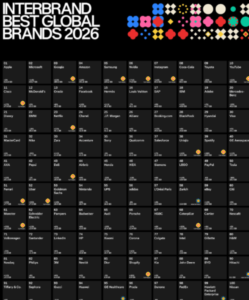
Interbrand Best Global Brands 2026
Hermès emerges as the world’s most valuable luxury brand
Hermès (#15, BV: $45.2bn) stood out as a top performer in the category, increasing its Brand Value by 10.6%, overtaking Louis Vuitton (#16, BV: 45.1bn) for the first time. Throughout the year, emphasis on craftsmanship, controlled scarcity and expanding experiential initiatives such as ‘Hermès in the Making’ have contributed to this success and provided resilience in a shifting wider luxury market.
Chanel (#24, BV: $32.9bn) also delivered strong growth, rising 8.1%, maintaining its position amongst the world’s most powerful luxury brands – thanks to an important period of creative renewal under new Artistic Director Matthie Blazy, bringing fresh energy to the brand, whilst retaining the design codes and creative identity that have made the icon distinctive.
Jewellery brands continue to shine
Cartier (#69, BV: $12.2bn) and Tiffany & Co (#91, BV: $8.1bn) grew 9.4% and 6.2% respectively, demonstrating that the winners in luxury are those who have strengthened desirability rather than relying on existing scale. Both brands invested in creativity, cultural partnerships and elevated retail experiences, highlighting how consumers reward brands able to unite heritage and contemporary service.
Heritage alone is no longer enough
Louis Vuitton (#16, BV: 45.1bn), once the largest brand by value in the sector, declined by 6.9% to $45.1bn, despite major investment into partnerships and category expansion. Dior (#85, BV: $8.9bn) fell 5.0%, while Gucci (#93, BV: $8.1bn) saw the sharpest decline, with its brand value falling by 30.7%, resulting in a 24-place drop to #93. Despite efforts to reset its creative direction, the brand continued to struggle with significantly reduced desirability and weak performances in key markets. Prada (#96, BV: $7.6bn) also struggled, falling ten places to #96, after a 15.1% reduction in Brand Value.
The results showcase a growing challenge for brands in luxury – heritage remains valuable, but consumers expect brands to evolve culturally and creatively, while remaining authentic to the qualities that made them desirable in the first place.
What did the winners get right in 2026?
This year’s ranking suggests that luxury is entering a period of polarisation, where brands with exceptional desirability, coherence and authenticity can thrive, whilst others are finding that legacy and heritage no longer guarantee growth. Luxury is no longer about what a product does, but what a brand means.
Brands which create value through disciplined brand development surpass those who have relied on heritage, scale and momentum. Hermès showcased how effective positioning, scarcity, and emotional connection can reinforce brand strength and commercial performance, whereas Gucci’s decline demonstrated that even the most powerful brands must continue to earn relevance and maintain consumer desire.