 Take-home sales at the grocers increased by 2.4% in the four weeks to 14 June 2026, according to the latest data from Worldpanel by Numerator. Like-for-like grocery inflation stood at 3.0%, offsetting concerns about the impact of the conflict in the Middle East filtering through to Britain’s supermarket shelves.
The period coincided with the UK’s hottest May day on record and a ten-day heatwave, driving strong demand for summer staples among shoppers. Suncare sales more than doubled (+128%), while fresh beef burgers were up 40%. Fresh prepared salads and chilled dips each grew by 13%, as households looking to take advantage of the warm weather wheeled out their barbecues.
No- and low-alcohol drinks also performed strongly, up 23% and outpacing the wider beer and cider category, which saw growth of 6%. Syrups for water were another winner over the four weeks, up 31% year on year, indicating that online viral trends such as #WaterTok, the trend of mixing sugar-free syrups into water popularised on platforms such as TikTok, are filtering through to shopper behaviour.
Fraser McKevitt, head of retail and consumer insight at Worldpanel by Numerator, said: ”There’s something very British about the way a heatwave changes the weekly shop, and shoppers didn’t need much encouragement to fire up the grill and turn to al fresco dining this time around.
“Barbecue staples performing well and shoppers turning to healthier options are a common summer trend, and we can expect to see this continue over the rest of June and into July, with the warm weather forecast to continue.”
Worldpanel data shows that spending per person on food nearly doubles when households are barbecuing. Spend per head stands at close to £5.00 for barbecue meals, compared to just over £2.50 for meals prepared inside.*
Retailers ramp up promotions as World Cup kicks off
With the FIFA Men’s World Cup firmly under way, football fan favourites are seeing their highest promotional activity in June for five years. Beer and cider, snacks and crisps and chilled pizza have all been hotspots for deals, as retailers compete for basket space among fans stocking up ahead of matches.
Promotions are playing a broader role across the wider market. The share of grocery spending on promotion rose year on year for the 39th consecutive month, with 30.4% of all sales now on some form of deal.
Online grocery continues to grow ahead of the total market. Combined online sales across all grocers rose 9.1% over the period, with nearly a quarter of British households making at least one online grocery purchase.
McKevitt added: “Nearly a third of all grocery spending is now on promotion, and that upward streak shows no sign of breaking. Combined with strong online growth, it points to shoppers who know what they want and are increasingly confident about where and how to find the best deal. In short, retailers are having to compete hard for that summer shop.”
Co-op returns to growth
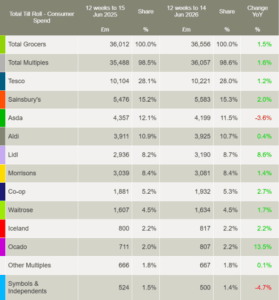
Ocado was once again the fastest growing grocer, with sales up by 13.5% over the 12 weeks to 14 June 2026 compared with the same time a year ago. As a result, Ocado share rose by 0.2 percentage points to 2.2% of the market.
Lidl attracted more than half a million additional shoppers through the tills over the 12 weeks in comparison to the same period in 2025. The discounter’s market share rose to 8.7%, up by 0.5 percentage points, which was the greatest increase for any retailer this month.
Convenience retailer Co-op also returned to market share growth, increasing share from 5.2% last year to 5.3% this year as sales grew by 2.7%. A cyberattack last year affected its figures for 2025.
Sainsbury’s also grew ahead of the market over the 12 weeks, with spending up by 2.0% and adding 0.1 percentage point of share, meaning Britain’s second largest grocer now accounts for 15.3% of sales.
Tesco, the UK’s largest grocer, now holds 28.0% market share, with sales growing by 1.2%. Morrisons share remained flat year on year at 8.4%, with sales up by 1.4%. Asda holds 11.5% share of all sales and Aldi has 10.7% share.
Sales at Waitrose grew by 1.7% and 2.2% at Iceland. Both retailers maintained the same market share, at 4.5% and 2.2%, respectively. Beyond the grocers, grocery sales at M&S** rose by 11.7% over the 12 weeks.