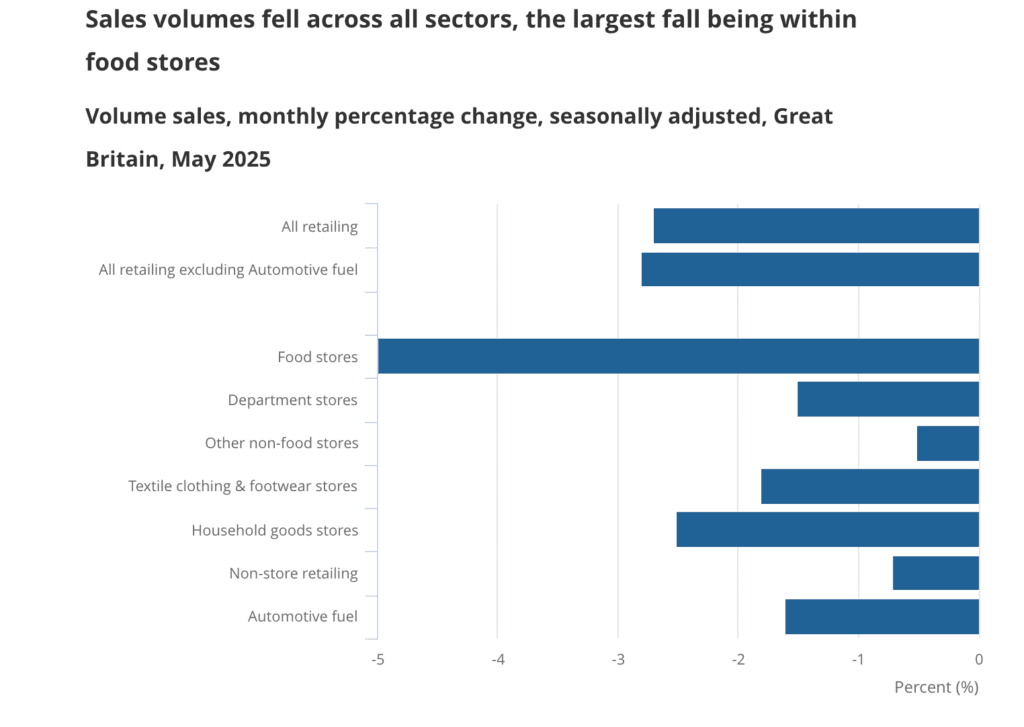
Retail sales volumes (quantity bought) are estimated to have fallen by 2.7% in May 2025, following a rise of 1.3% in April 2025 (revised up from a rise of 1.2%), the latest figures from the Office for National Statistics shows.
Food store sales volumes fell back in May. This followed a strong rise in April which retailers attributed to the good weather.
Despite this fall on the month, sales volumes rose by 0.8% in the three months to May 2025 when compared with the three months to February 2025.
Parcelhero’s head of consumer research, David Jinks, said: “It was too good to last… Over four consecutive months, Brits defied expectations and continued to buy more. April’s sales results have even been revised upwards by the ONS from 1.2% to 1.3%. But reality finally hit in May.
“Not only were sales volumes down 2.7% against April but they were also down 1.3% YOY against May 2024. Every category of retail saw a fall. Worst hit were supermarkets and other food stores, with their sales volumes down a whopping 5%. Supermarkets told the ONS that inflation was a factor, together with customers cutting back on spending. Reduced sales of alcohol and tobacco show the party was well and truly over for shoppers. This was food stores’ largest monthly fall since May 2021.”
Matt Jeffers, managing director, retail strategy & consulting at Accenture, said: “May brought summer-like weather, but shoppers kept their cool- and their cash. Retail sales suffered as consumers continued to feel the squeeze from rising household bills and an extended period of cost-of-living pressure.
“While improving consumer confidence offered a glimmer of hope, that sentiment didn’t translate into spending and sales were the lowest in months, with food hit particularly hard. Fashion, household goods and big-ticket purchases all saw weaker performance, with many households opting to cut back or trade down.
“Some of May’s softness likely reflects summer purchases brought forward into April, when Easter and spring bank holidays coincided with exceptionally sunny weather. But recent cybersecurity issues faced by a number of retailers will also have had an impact, disrupting stock availability.
“Retailers hoping to build momentum into summer will need to double down on clear pricing, simple loyalty mechanics and convenient, friction-free experiences, especially as attention shifts to holiday prep, events and outdoor categories. Loyalty schemes and smart pricing strategies will be key to staying relevant without eroding margin. And for bigger-ticket purchases, support through digital and post-sale service will be critical to convert browsing into buying.
Sagar Shah, associate partner at McKinsey & Company, comments: “Even the second sunniest May on record couldn’t stop retail sales slipping into the shade, down 2.7%. This is the first month this year that retail figures have fallen.
“All categories saw a decline. Food sales fell by 5%, despite people firing up BBQs. Household goods fell by 2.5% even with the summer months around the corner. These figures are in line with our latest consumer research data, which shows that 55% of consumers will spend less on home improvements. And, 42% expect to cut back on gardening supplies, in the next three months.
“The caution could in part be attributed to food inflation being at the highest level since February 2024. And, other fiscal pressures that retailers are facing that could potentially be impacting promotions.
“Looking ahead consumers are showing signs of caution. Our data shows just over half (51%) of UK shoppers say rising prices and inflation is still their top concern.
“What’s becoming increasingly clear is that consumer sentiment and spending patterns are no longer neatly aligned. Retailers will be looking to get even closer to shoppers to stay ahead, tapping into real time data and smarter tools to inform their pricing and promotional strategies.”
Oliver Vernon-Harcourt, head of retail at Deloitte, said: “For the first time this year, retail sales fell more than expected, as two bank holidays and further good weather were not enough to entice spending. A late Easter combined with the sunniest April on record brought some seasonal sales forward, meanwhile continued inflationary pressures from food, furniture and household goods hampered sales volumes.
“Overall, consumers remain cautious in the face of persistent inflation, increased utility costs and ongoing geopolitical uncertainty. While this transpired into fewer purchases in May, there is a broader picture of improving household finances. Consumers have been saving at one of the highest levels on record, and with robust real wage growth, this could generate some helpful tailwinds for the retail sector throughout the rest of 2025. With warm weather set to continue, retailers will hope to see a boost from the sale of summer food, clothing and outdoor offerings, resulting in a return to growth in the months ahead.”
Deann Evans, managing director, EMEA, at Shopify, commented: “Retailers will be disappointed to see a fall in sales in May, especially after consecutive rises. This may be attributable to the 3.4% inflation rate, or lasting effects from April’s increases in annual domestic bills and National Insurance contributions. These constraints can shrink disposable income, as illustrated by the latest BRC-KPMG Retail Sales Monitor revealing consumers are cutting back on non-essential spending.
“However, there is reason to be optimistic that the summer months and warmer weather will inspire increased consumer spending and a return to sales growth. According to our Shopify data for May, UK consumers were busy preparing for aquatic fun with sales of Pool Floats & Loungers (+101%), Child Swimming Aids (+74.7%) and Swim Goggles & Masks (+62.4%) all rising significantly compared to April.
“Perhaps even more impactful will be the cultural moments that summer brings. Just like we saw with Taylor Swift’s Eras tour last year, the “Beyonce Effect” is in full swing as she brings her Cowboy Carter tour to the UK. Our data reveals a significant increase in the sales of western fashion items last month compared to May 2024, such as denim shorts (+52%), cowboy hats (+288%) and belts (+62%). With Glastonbury Festival and the Oasis tour close on the horizon, there is a significant opportunity here for retailers to capitalise—provided they have the right tools and systems in place. A strong digital presence and social media strategy are particularly key to winning the lottery ticket of celebrity influence and having the right people notice your products, and retailers must keep this front of mind this summer.”
Jim Rudall, regional director, EMEA at Intuit Mailchimp, commented: “Retailers will be disappointed to see a fall in sales figures in April, especially with high expectations for a boost around the May bank holidays – which our New E-Commerce Calendar report ranks as the top two shopping moments for UK consumers in May (based on spending propensity).
“However, there is reason to be optimistic that the core summer months can bring a return to sales growth. This is driven by the swathe of cultural moments that get underway in June, such as Glastonbury, Royal Ascot and the FIFA Club World Cup. Our New E-Commerce Calendar revealed major entertainment events and music festivals prompted 15% of shoppers to make purchases in the last two years – offering brands the chance to ride a cultural wave and flex their personalities. This might be through cross-brand collaborations, hopping on the latest viral trend, or releasing a timely limited-access experience.
“There is also Father’s Day, which our research identified as the most significant shopping moment for June. However, it is crucial that marketers are thoughtful in their approach around these potentially sensitive calendar moments. Indeed, our Brand Trust report found 52% of UK consumers said they appreciate opt-out campaigns around emotive calendar days such as Mother’s Day and Father’s Day.
“To position themselves for success, retailers must consider how they can stand out against competitors in what is a crowded promotional landscape. For UK consumers, loyalty rewards can be particularly impactful. According to our New E-Commerce Calendar, 43% of British shoppers were influenced by loyalty reward perks to make a purchase in the last 2 years – well above the global average of 33%.”