
 By Katy Pigg – global head of category ‑ bottles & soothers, Tommee Tippee
Consumer insight: What are some of the biggest challenges parents face when it comes to feeding, and how are these insights influencing Tommee Tippee’s approach to product development?
First-time bottle acceptance can be a big challenge for parents, whether they’re bottle feeding from birth or transitioning to a bottle from breast. In research, 83% of parents surveyed said they had trialled multiple bottle brands before finding one their baby would accept.* A process that is both expensive and stressful.
We also know that acceptance rates are highly impacted by teat shape (how baby latches) and flow rate (the pace at which they feed).
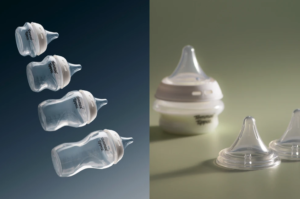
At Tommee Tippee, we used these insights to inform the development of our new Perfect Latch Trial kit, which offers a choice of two teat shapes for parents to try with their baby, both of which fit onto the same bottle base, for less waste. Once baby’s teat shape preference has been determined, parents can then tailor the flow rate for their baby as they grow, from extra slow, through to fast flow.
The thinking behind the launch: What inspired the Natural Start Perfect Latch Trial Kit, and was there a particular gap in the market or feedback from parents that led to its development?
The development of this kit was informed by consumer insights (as outlined above). In addition, our social listening and consultations with healthcare professionals highlighted that many babies prefer a triangular-shaped teat because it promotes a deeper latch. No other brands seemed to be positioning themselves as “best for acceptance”, and we felt offering teat choice, for a more personalised latch, would be a real opportunity to help parents succeed at that first feed. Indeed, in our consumer trials, the combination of our wide and deep latch teats achieved 98% first-time acceptance.**
Product development: How did working with healthcare professionals help shape the kit, and what were some of the key considerations during development?
We worked with healthcare professionals on the development of the Perfect Latch Trial kit, for both the deep latch teat shape and the smaller newborn bottle. Through listening to healthcare professionals, we knew there were two main tensions we wanted to address with this kit. Firstly, offering babies choice through teat shape, as we know each baby is different and therefore latches differently, there was also a trend within healthcare professionals around a more triangular-shaped teat to reach the soft palate of babies’ mouths more easily. Secondly, our smaller newborn bottle helps to accurately measure smaller quantities of expressed breast milk and reduces the chance of overfeeding a newborn baby, a tension healthcare professionals spoke to us about. This iterative process of working with healthcare professionals happened at multiple stages of product development and their feedback directly influenced the evolution of the product.
Retail and the wider category: How do you see innovation shaping the baby care retail category, and what opportunities are there for brands to better support parents at the point of purchase?
A lot of innovation in our industry is designed to make parenting easier. Be that by helping them raise a more content and comfortable baby, by making parenting chores easier or by giving them added reassurance.
At Tommee Tippee, we operate across multiple baby categories and we put the needs of parents and babies at the heart of everything we do. The perfect latch trial pack is an example of an innovation that delivers against all 3 of the above. A better latch and flow delivers a more comfortable feed for baby; a 98% acceptance rate removes the stress and cost to parents in trialling multiple bottle brands and the fact the pack was developed with healthcare professionals should provide reassurance that they’ve made a good choice.
*Based on third-party research of 834 parents in the US with a child aged 0-23 months, who were asked about their bottle-feeding purchase journey (May 2025)
**Based on an independent survey of 89 parents in UK and US with a child aged 0-12 months, who trialled the Deep and Wide Latch teat range (November 2025)