

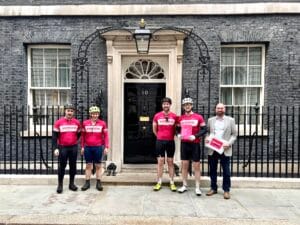
 Yesterday a group of cyclists completed a 200km ride from Irthlingborough to Downing Street, delivering a petition backed by health professionals and organisations calling on the UK Government to formally review and refresh the 5-a-day dietary guidelines.
The ride marks the culmination of the Gaps to Gains campaign; an initiative focused on tackling the UK’s growing diet-related health crisis by shifting attention towards the nutrients and foods missing from people’s diets.
Riders arrived at Downing Street yesterday afternoon to hand in the petition alongside the Gaps to Gains white paper, which highlights the urgent need to address widespread nutrient deficiencies across the population.
A nation facing a diet-driven health crisis
Poor diet is now one of the leading causes of preventable ill health in the UK, contributing to rising levels of obesity, type 2 diabetes and cardiovascular disease, and placing increasing strain on the NHS and wider economy .
Yet experts warn that the conversation has become too focused on reducing unhealthy foods, and not enough on what people should be eating more of.
“What we’re not eating is causing as much harm as what we’re having too much of,” said Phil Gowland, Director of Health at Whitworths. “If we are serious about improving the nation’s health, we must close the nutrition gap, not just fight the excess.”
A call to build on one of the UK’s most successful health campaigns
The petition calls on government to:
- Commission a formal review of the 5-a-day framework
- Ensure it reflects the latest nutrition science and current health challenges
- Consider how it could be strengthened to better support nutrient intake across the population
Campaign leaders emphasise that this is not about replacing 5-a-day, but building on its success, evolving a highly recognised and trusted framework to deliver even greater public health impact.
As part of this review, the campaign encourages government to explore whether a broader range of nutrient-dense foods such as wholegrains, legumes, nuts and seeds could play a role in helping people meet their nutritional needs.
Turning “Gaps to Gains” into action
The 200km ride symbolises the distance between awareness and action in tackling diet-related disease and the collective effort required to bridge that gap.
“This ride represents more than a journey – it’s a statement,” added Gowland.
“We have the evidence, we have the opportunity, and we have one of the most powerful public health tools in 5-a-day. Now is the time to strengthen it.”
A positive approach to public health
The campaign reflects growing evidence that positive dietary guidance focused on what to eat more of is more effective at driving long-term behaviour change than restriction alone.
With widespread nutrient gaps in fibre, healthy fats and micronutrients, campaign leaders argue that strengthening public guidance could play a critical role in reducing preventable disease and improving long-term health outcomes.