
As the cost-of-living increases, and household budgets get tighter, are consumers turning to the freezer aisle?
YouGov Profiles data explores how often consumers use frozen food, what drives their purchasing decisions, and how these behaviours vary across income groups.
How often do Britons use frozen food?
 Around seven in ten consumers use frozen food to prepare meals at least two to three times a week. The most common frequency is two to three times a week (41%), followed by four to six times a week (21%). A further 16% use frozen food once a week, while 7% say they use it every day.
Lower-income consumers report the highest levels of regular use. More than one in 10 (11%) use frozen food every day, compared with 8% of middle-income and 4% of higher-income consumers. They are also the most likely to use frozen food four to six times a week (27% vs. 22% of middle-income and 17% of higher-income consumers).
Despite these differences in frequency, purchasing habits have remained largely stable over the past year. Nearly three-quarters (72%) say they buy frozen food about as often as they did 12 months ago, while 11% purchase it more frequently and 15% less frequently. Lower-income consumers are slightly more likely than average to report both increasing (13%) and decreasing (18%) their frozen food purchases over the past year, with 68% reporting no change.
What make Britons buy frozen food?
Value for money is the strongest purchase driver, cited by 62% of consumers. It is followed by quality of food (50%) and taste (47%). Convenience-related benefits also rank highly with more than two-fifths picking simplicity to cook (43%) and quick preparation (41%).
Previous experience with a product (41%) and ease of storage (41%) are selected by similar proportions, while 38% say retaining freshness influences their decision.

Lower-income consumers are the most likely to buy frozen food because it offers good value for money (65%), while higher-income consumers place relatively greater emphasis on retained freshness (42% vs. 33% of lower-income consumers) and health (31% vs. 25%).
Do Britons stay loyal to frozen food brands?
Fewer than half of consumers (44%) agree that they always stick to the same frozen food brands, while 38% disagree and 18% neither agree nor disagree.
Brand loyalty is slightly stronger among lower-income consumers, with 48% agreeing that they stick to the same brands, compared with 45% of middle-income and 42% of higher-income consumers.
Which frozen food categories are most popular in Britain?
Frozen potato products, including chips, roast potatoes, hash browns and potato waffles, are the most widely purchased frozen food category, with 77% saying they would consider buying them already frozen.
Desserts and ice cream (63%) and pizzas and garlic bread (61%) follow, ahead of frozen vegetables or fruit (55%), processed meat or fish such as fish fingers and chicken nuggets (52%), and fish and seafood (45%).
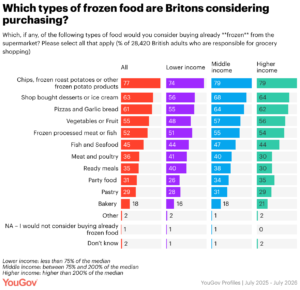 Some categories show clearer differences by income. Higher-income consumers are less likely than lower-income consumers to consider buying frozen meat and poultry (30% vs. 41%) and ready meals (30% vs. 40%). Meanwhile, middle- and higher-income consumers are more likely than lower-income consumers to consider buying frozen desserts or ice cream (68% and 64% vs. 56%) and frozen potato products (79% each vs. 74%).