 The online shopping portal of 2026 is no longer a passive catalog; it is a dynamic and proactive entity that recognises a customer’s demands before he/she presses the ‘Search’ button. In the current world scenario, where browsing is the automatic mode of millions of web surfers, the task at hand for e-commerce businesses is not to attract traffic but retain it.
The traditional leaky bucket of e-commerce, where high traffic rarely translates to high conversion, is finally being patched by Artificial Intelligence. This shift isn’t just about efficiency; it’s about relevance. When a customer feels understood, they stop scrolling and start buying.
The shift from discovery to decision
For years, the internet was a place of endless searching. Today, it is becoming a place of discovery. AI has shifted the retail paradigm from reactive to predictive. Retailers are now using Agentic AI to analyze millions of data points, from local weather shifts to viral social trends, to ensure that the storefront a customer sees is tailored specifically to them.
This level of precision is fundamentally changing how brands communicate with their audience. According to Push Group’s CEO, “What’s really happening in 2026 is not merely employing AI for automation or for more efficient writing, but also for pinpointing exactly where that next customer is going to be hidden even before you’ve spent a dollar on marketing.” He further explains, “With AI, you’re not just finding a customer, you’re predicting one. You’re taking all of that information and turning it into a road map for success.”
This perspective aligns with the broader industry movement toward scaffolding human potential. As Satya Nadella, CEO of Microsoft, recently noted in his 2026 outlook, “AI must be positioned as scaffolding: a structure that supports, amplifies, and extends human capability rather than replacing it. It reframes AI not as a tool we operate, but as a system that surrounds us – shaping how we work, decide, and collaborate.”
Strategic pillars: how AI closes the sale
To understand how these high-level concepts translate into revenue, we have to look at the specific, data-driven ways AI is currently helping retailers turn browsers into buyers.
- The death of the generic home page
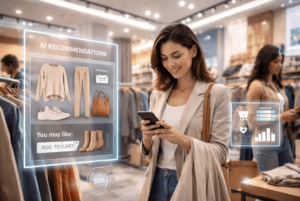
AI has officially killed the one-size-fits-all website. Modern retailers use “hyper-personalization” to change website layouts in real-time. If an AI detects a user has been searching for “cold-weather hiking gear” on other platforms, the retail site will automatically prioritize thermal layers and waterproof boots the moment they land on the page. Research from Adobe Analytics shows that in March 2026, AI-driven traffic converted 42% better than human traffic, largely because the content was optimized for the specific intent of the visitor.
- Conversational commerce and transactional bots
We have moved past the era of simple chatbots that merely deflect tickets. Today’s AI agents are transactional. They don’t just tell you where your order is; they can independently issue refunds, suggest a matching accessory for a dress already in your cart, or provide technical side-by-side comparisons of two different laptops. This Agentic CX is driving a 30-40% reduction in support costs while simultaneously increasing the Add to Cart rate.
- Visual search as a bridge to purchase
Confidence is the primary driver of conversion. AI-powered visual search allows a user to snap a photo of a pair of sneakers on the street and find the exact match in a retailer’s inventory within seconds. Furthermore, Augmented Reality (AR) try-ons allow browsers to see how a sofa looks in their specific living room lighting. When the uncertainty of “Will this look good?” is removed, the path to the “Buy Now” button is clear.
- Self-healing supply chains
There is no faster way to lose a buyer than an out-of-stock message. AI is now used for Demand Sensing, which monitors soft signals like a sudden spike in TikTok mentions or a predicted heatwave in a specific region. AI then triggers the redistribution of inventory before the shelf goes empty. According to McKinsey, retailers using these Self-Healing supply chains see up to 90% faster inventory redistribution, ensuring that the product the browser wants is actually there to be bought.
- Dynamic pricing and ethical personalization
AI systems can now adjust prices in real-time based on competitor activity, inventory levels, and customer loyalty. However, the most successful retailers are using this for loyalty-based pricing, offering a personalized discount to a browser who has visited a product page three times but hasn’t yet pulled the trigger. This nudge is often the final piece of the puzzle.
The guman factor in a tech-driven world
Despite the heavy reliance on data, the most successful AI implementations are those that feel human. The technology should be invisible; the customer should simply feel that the shopping experience was remarkably easy.
As Doug McMillon, former CEO of Walmart, pointed out regarding the digital transformation, “The future of retail isn’t about replacing human connection with machines, it’s about using AI to remove friction and make everyday moments easier, smarter, and more delightful.”
Conclusion: the path forward
The purpose of using AI for retailing is neither to dupe a visitor into buying something that they do not actually need. Rather, it is all about valuing the time of the user through an experience that is quick and relevant to their needs.
With the help of AI, the internet is moving from being a warehouse to becoming a boutique that caters to individual needs. The implication for businesses is clear: if they fail to use AI to uncover their customer’s true intent, they might just be locking their own doors.
So, have you embraced AI to turn browsers into buyers, or are you unknowingly locking the door of your retail store? Let us know in the comments.