
By Jeff Griffin, vice president, strategic accounts, Nfinite
 Sustainability has become a critical consideration for retailers in recent years as consumers become increasingly environmentally conscious. This trend has led retailers to realise the importance of reducing their carbon footprint not just for cost savings but also for the benefit of the planet. The Global Sustainability Study 2021, conducted by global strategy and pricing consultancy Simon-Kucher & Partners, revealed that more than a third of global consumers are willing to pay more for sustainability as demand grows for environmentally-friendly alternatives.
As consumers become increasingly aware of the urgent need for environmental action, businesses will be compelled to showcase their sustainability endeavours and integrate them into their core value proposition. The pressure to do so will continue to intensify as consumers demand that companies take responsibility for their environmental impact and align their operations with the principles of ecological responsibility. In short, retailers that fail to prioritise sustainability will find themselves on the wrong side of public opinion, with dire consequences for their bottom line and long-term viability.
Walmart is one of the pioneers of sustainability. Project Gigaton™ aims to reduce or avoid one billion metric tons (a gigaton) of greenhouse gases from the global value chain by 2030. In the retail sector, most emissions exist in product supply chains rather than stores and distribution centres. That’s why Walmart created Project Gigaton™ in 2017 to engage suppliers in climate action, along with NGOs and other stakeholders.
CGI and 3D technology to reduce retailers’ carbon footprint and meet consumer expectations
 Sustainability initiatives are also used to enhance a retailer’s brand perception. Most green efforts focus on sustainable production processes, sustainable packaging, the use of renewable energy, green and recyclable material sourcing, recycling during the product lifecycle, and sustainable marketing processes. Other activities include green office spaces, sustainable equipment, and energy-saving operations.
Emerging technologies, such as CGI and 3D imagery, offer new innovative opportunities to create greener marketing processes, including decarbonizing the merchandising process in e-commerce.
For instance, as shoppers increasingly rely on visuals to inform their online purchase decisions, retailers are pressured to produce multiple visual images per product, which generates a significant carbon footprint in the traditional photo shoot process. According to a survey by Coresight Research, 81% of brands and retailers typically display at least five product visuals for a single product on their websites. This challenge is compounded by the need to produce visuals for other channels with different requirements. CGI and 3D technology can be used to create product images sustainably, reducing the need for photo shoots.
Reducing e-commerce returns and cutting carbon emissions with CGI visuals
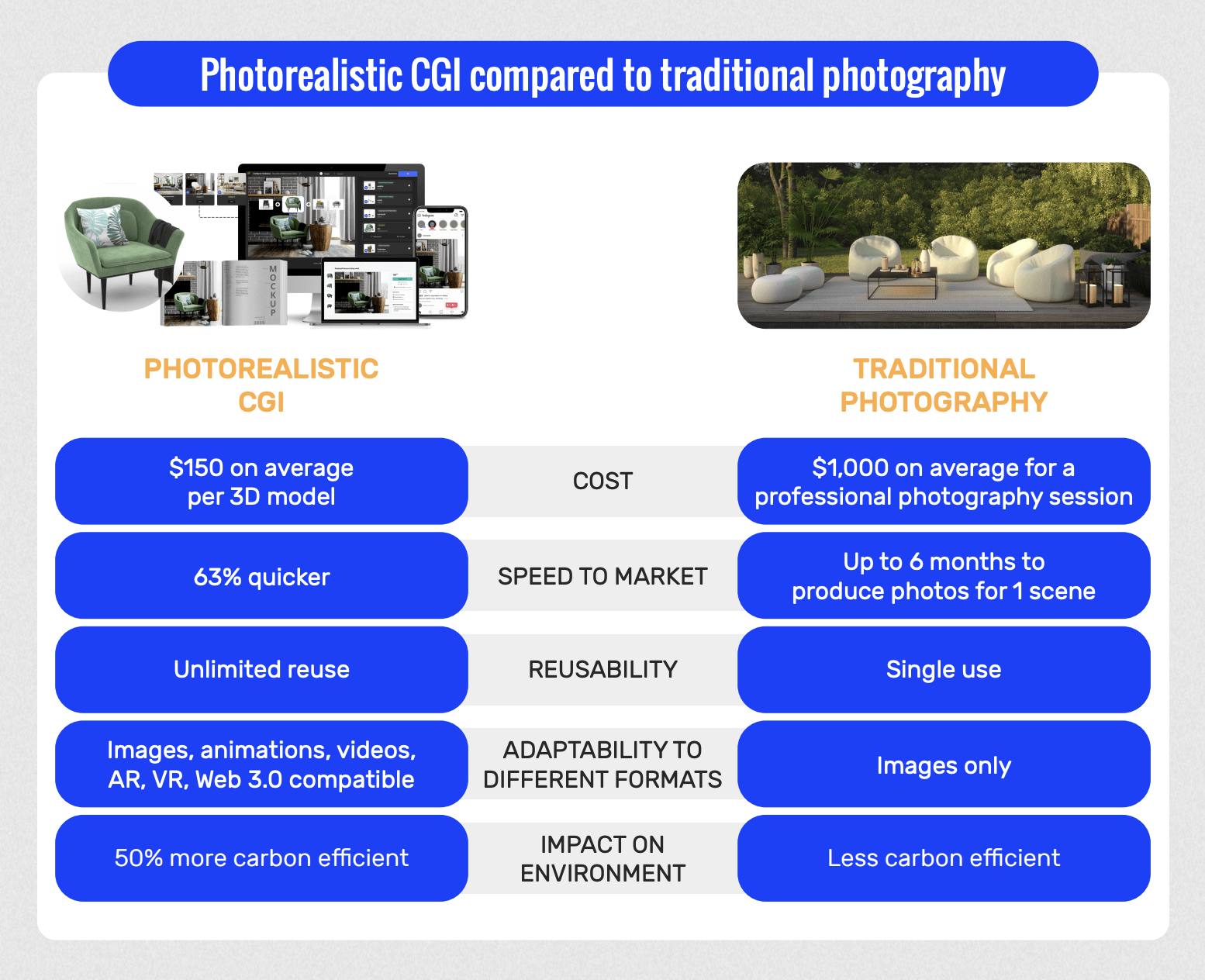 Another significant environmental (not to mention financial) challenge for e-commerce retailers is reducing the number of product returns. Coresight Research revealed that 55% of brands and retailers experienced online product returns of over 10% last year due to product visuals not accurately reflecting the actual product received by customers. Reducing return rates is essential to reducing carbon emissions.
According to Coresight Research, the furniture and the home-furnishing sector had the highest average return rate of 14%, followed by big-box retailers/mass merchandisers at 13% and CPG brands and retailers at 11%. This may be due to the larger size of home products and the need for proper sizing. However, high-quality product visuals, such as CGI offering 360-degree views, can help consumers examine products closely and increase confidence in their purchase decision. Coresight Research found that this can reduce the environmental impact of product returns and increase shopper trust, which 52% of brands and retailers investing in CGI recognise as a key benefit.
However, Coresight Research found that relatively few brands and retailers recognise that CGI has a sustainability aspect: only 39% of brands and retailers investing in CGI think it improves their carbon footprint. CGI, which enables the creation of product visuals without physical samples, can also reduce resource waste and the production of excess inventory. As Gartner Analyst Mark Lewis recently pointed out in his Market Guide for Composable Product Configurators, “Virtual photography avoids having to build samples for a physical photo shoot. In addition, if a new colour or option is added to the range, it is easy to generate new images for the catalogue without setting up a new photo shoot.” The implication is clear – companies that take advantage of this new technology will see a positive impact on their carbon footprint while also saving time and money.
Creating a sustainable business model that benefits the planet and people
Retailers are becoming increasingly aware of their products’ carbon footprints. As shoppers become more environmentally conscious, sustainability is becoming an essential consideration for retailers. Retailers must incorporate sustainability into their overall business processes to attract shoppers. By adopting source reduction techniques, using CGI and 3D imagery, sourcing materials from sustainable and ethical sources, and making the shipping process more sustainable, retailers can build trust and loyalty with their customers while positively impacting the environment. Ultimately, the key is to balance business needs with the planet’s needs and create sustainable business models that benefit everyone.