
Retail boardrooms have spent a decade debating the same question: how many stores do we actually need, and what are they for? While that debate rumbles on, one consumer category has already lived through the entire cycle, from counter service to app-first, and come out the other side with a settled answer.
The British betting industry digitised earlier, faster and more completely than almost any other high-street business, and the way its operators handled the transition holds practical lessons for retailers weighing their own channel mix.
A sector that digitised first
The numbers tell the story plainly. According to the Gambling Commission’s industry statistics for April 2025 to March 2026, the sector generated £17.5 billion in gross gambling yield, up 4.4% year-on-year. Within that, the remote casino, betting and bingo segment produced £8.3 billion, growing at 6.9%, while all land-based sectors combined managed £4.9 billion and growth of just 1.1 %. Online is now both the larger channel and the source of virtually all the growth.
The physical estate has adjusted accordingly. Great Britain counted 8,423 betting shops in September 2018, on the Commission’s own figures. The latest count is 5,617, down 3.6% in a year and roughly a third in under a decade. Total licensed gambling premises now stand at 8,081. That is not a collapse; it is a managed contraction, and the distinction matters.
The retail parallel
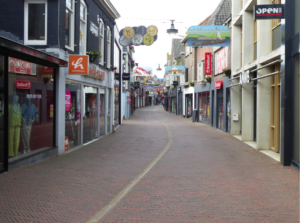
Retail is traveling the same road at a gentler gradient. ONS figures put internet sales at more than a quarter of total UK retail sales, and high-street footfall has continued to fall year on year through 2026, according to BRC-Sensormatic data. The strategic question facing a fashion chain or a grocer in 2026 is the one betting operators faced in the mid-2010s: when the till migrates to the phone, what is the shop for?
The betting industry’s answer was not “nothing”. The operators that navigated the shift best did not simply race to close premises; they rebuilt the estate around a different job description, the same omnichannel logic that retail’s own strategists now advocate: the shop as brand presence, service point and acquisition channel, with the app as the engine of range and revenue.
The operator that kept its shops
A useful case study comes from outside Britain. Hollywoodbets, a South African operator that entered the UK market in 2019 and holds a Gambling Commission license for its British arm, opened its first betting branch in Durban in 2000 and grew into a household name at home through physical shops, around 84 of which still trade across South Africa’s provinces.
What changed is where the growth sits. The company still operates its retail branches, but the engine is now its digital estate, where product ranges, from sports markets to the online slots lobby on its international platform, expand at a pace no counter service could match. A shop has finite counter space and opening hours; a digital lobby adds products the way an e-commerce site adds SKUs. The physical branches did not disappear when that became true. Their role changed: local visibility, cash customers, and a brand anchor in communities where the company built its name.
 What transfers to retail
 What transfers to retail
Three lessons from betting’s migration travel well beyond it.
Treat footfall as marketing, not just revenue. Betting shops stopped being judged purely on over-the-counter takings long ago; they earn their keep partly as brand presence. Retailers doing the same arithmetic often find a store’s contribution to local online sales changes the closure calculus.
Let the digital channel carry the range. The physical estate holds the edited, high-conviction offer; the long tail lives online, where shelf space is free. Betting operators learned this early because their product count exploded online while shop counters stayed the same size.
Build the loyalty loop across both. The most valuable customer is the one who uses both channels. McKinsey’s omnichannel research found omnichannel customers purchase up to 70 percent more often than their offline-only peers, which is precisely the behavior a well-run cross-channel estate is designed to produce.
The caveats that keep it honest
Not everything transfers. Betting is a tightly regulated category, and part of its shop decline reflects regulation as much as consumer preference, a pressure most retailers do not face. And the products themselves are not comparable to a basket of groceries: gambling is adult entertainment with real financial risk, which is why its digital growth has been accompanied by ever-stricter player-protection rules rather than pure growth-hacking.
But as a preview of where a channel shift ends up, the sector is hard to beat: a smaller, repurposed physical estate; a digital channel carrying the range and the growth; and the winners being the operators who treated the two as one business rather than rivals. The high street’s future may look more like that than either the doomsayers or the store-forever romantics expect.
Gambling products referenced in this article are for adults aged 18 and over. Anyone concerned about gambling can contact GamCare’s National Gambling Helpline on 0808 8020 133, free and confidential, 24 hours a day.