

AI, unified commerce, retail media, RFID and computer vision were the leading themes at NRF 2026. That’s according to Mark Thomson, retail industry director EMEA, Zebra Technologies, a leader in mobile computing, barcode scanners, RFID readers, thermal printing and retail task management software.
Exhibiting at this year’s event, Zebra Technologies welcomed delegates from around the globe including Latin America, North America and Europe, hosting retailers at its booth and across 10 meeting areas.
AI: use cases versus possibilities
AI, no surprise, was the buzz word at the event. JD Sports, for instance, picked NRF 2026 to showcase its AI-powered shopping collaboration, which enables shoppers to purchase products directly through AI such as ChatGPT.
The model bypasses traditional search engines. Thomson suggested the move, also seen at Walmart, meant search engines may be dead when it comes to retail. Search from within generative AI engines would be more focused and targeted, driving consumer trust, he said.
“AI was the big takeaway. Last year the theme was that AI might be able to help. This year it moved to ‘here is what we’ve developed for practical AI usage’,” Thomson said.
This ranged from applications for the consumer such as self-service kiosks in-store with improved interactions through to solutions that enhance or augment store staff.
“There was very little little talk around autonomous stores. It does seem to be palpable shift,” Thomson said. “Autonomous has its place but is not front of store retail. Rather, AI is there to augment staff and there will be a clear differentiation between those retailers that allow staff to be augmented with AI and those that don’t.”
Delivery or implementation is key, however.
“You can’t assume because staff access it [AI] at home that it translates to the work environment. It’s a change management process,” Thomson said. He stressed the need for retailers to remove scepticism that AI would steal retail roles with messaging that the tech would make jobs more enjoyable.
Unified commerce trend
Physical retail is also making a come back, especially for Gen Z Thomson reported. While Millennials are still doing more online, Gen Z is heading back to store and craves physical experiences, he said.
Multi-channel and omni-channel don’t really exist anymore and all routes to reaching the customer are symbiotic, Thomson argued. “It’s unified commerce with the ability to to go online and buy something, pick up at a store and possibly return it later to a physical store.”
The key is understanding the data around all of those touch points and the associated product inventory. With orders increasingly picked from store, stock accuracy is vital, Thomson maintained.
From the retailer’s point of view, operators want interoperable solutions that talk to each other, versus solutions that operate in isolation, he added. “They want one dash board where they can see what’s happening in stores.” Thomson likened it to a NASA operations room, where retailers can see everything across the store. The proliferation of devices and AI is starting to deliver the promise of connected stores, he opined.
RFID provides online-equivalent insights
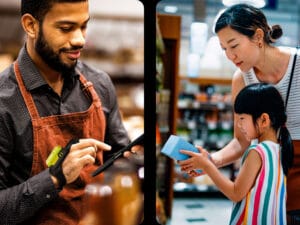
RFID is hot, especially in fashion but is moving into DIY and health and beauty channels but also the food space, where chip-based tech carries more detail than a barcode i.e. sell and use by dates.
On the fashion side, meanwhile, RFID creates smart and intelligent stores where all products are tagged and readers in the ceiling can detect if items are picked up, taken into a fitting, tried on, and whether one or more items are bought etc.
Thomson said that generated the same insights that retailers see online.
“We’ve not had that depth of information in a physical store before. The digital information that perpetual RFID gives us provides a layer of information we have not had before,” he said.
In practical terms, this tech gives retailers increased visibility on conversion rates across male and female fitting rooms, for example; as well as time of day and enables stores to plan staffing to cater for peaks etc.
However, the tech must enable better journeys and reduce friction across three key flows, Thomson said. These are:
- The shopper journey
- The staff journey
- The product journey
Nailing those three flows will create success, he said.
Computer vision cuts theft
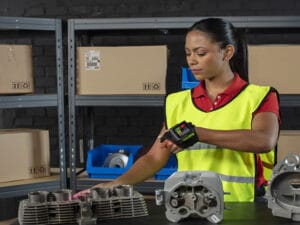
While RFID is great at providing visibility of products in fashion, in grocery computer vision is becoming increasingly important, to tackle shop theft but also maintain on shelf availability and accurate merchandising, which is important for the leading FMCG brands.
The trend to quick delivery/commerce, with products picked in-store, is putting further pressure on stores to understand their availability.
However, the trend to q-commerce, where orders are placed via aggregator apps like Uber Eats or Just Eat, risks retailers losing a direct relationship with the shopper, Thomson warned. In the future, white label solutions could take customers to the retailer’s app with the logistics element handled by the aggregator.
Retail theft and shrink was a big topic of conversation at NRF, Thomson said. Conversations were based on solutions that stop people stealing or making errors across the entire shopping journey. These include computer vision and RFID labels on boxes at pallet level to avoid supplier errors.
While computer vision can help to detect theft straight from the shelves, arguably the biggest area of loss in-store, the challenge is how to deal with that insight without putting staff in danger, Thomson said. As a result, the focal point for tech is at the point of sale, where shrink does happen but is more controllable.
Here, computer vision can detect when shoppers are not scanning bar codes, or stacking products to bypass scanning individual items or making product substitutes eg scanning more expensive Pink Lady apples as cheaper Red Delicious varieties; which causes further issues when linked to a replenishment system.
According to Thomson, more companies are now working in the computer vision space, which showed the tech is more mature and that a significant percentage of scanning errors – intentional or unintentional – could be solved with a nudge.
The online channel has an advantage in this respect, Thomson added. Here, operators have control of stock so there’s no customer shrink, although they could be targeted in other ways eg fraudulent cards etc.
Retail media and in-store interactions
Retail media was another hot topic across the booths at NRF including the use of upsell tools i.e. using AI to develop rapid scripts in response to a return, so that retailers don’t completely lose the sale; as well as to sell add-ons.
“Retailers have to find as much revenue as they can from all sales and AI can create that hype, sending messages to customers while they are shopping,” Thomson said.
This ranges from messaging on digital signage to targeting scan-and-go shoppers with special offers while they shop.
In addition, there are certain areas of stores where people need more help, Thomson said. In DIY stores, for instance, paint is one department with the greatest number of customer requests for help. Here, smart kiosks can provide the right customer information, using AI to narrow search results but also provide information that is based on the actual stock available in that specific store in real time.
Similarly, self service interactive touch screens can help to create more interactions in-store and, as a result, the conversion rate goes up, Thomson said.