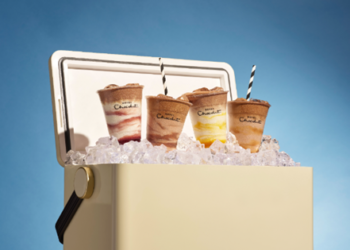

An AI image generator tool has revealed what the future of supermarket shelves might look like if products showcased their impact on CO2 emissions.
The research, carried out by food regulatory consultants Ashbury, took 30 popular food items found in the average household and used the BBC’s Climate Change Food Calculator to establish the amount of CO2 per kg emitted for a portion of food. They then used this information to work out the emissions per standard quantity of food in a typical package size.
Labelling has often had to fight its corner with brands continuing to face challenges in finding a model that works. The traffic light labelling system is just one of those, with the voluntary scheme introduced by the government in 2007. This research follows a soaring demand for consumers to have even clearer information about how their food got to their table and the impact its journey has had on the environment.
Ashbury used results from the calculator to establish what these emission figures could mean in our everyday lives, including; the number of miles travelled in a petrol car, the number of days heating an average UK home, litres of water used / number of showers lasting 8 minutes and the equivalent in square metres of land used.
Ashbury used the AI image generator Midjourney to then generate what these labels might look like in the future, were this method to be adopted by retailers.
Food item: Coffee
Quantity: 300g
Greenhouse gas emissions: 15.34kg
Image reference: Ashbury_CarbonFootprint_
Food item: Tea
Quantity: 200 Tea Bags
Greenhouse gas emissions: 8.21kg
Image reference: Ashbury_CarbonFootprint_
Food item: Beef
Quantity: 500g
Greenhouse gas emissions: 51.53kg
Equal to: 131.43 miles driven in a petrol car
Image reference: Ashbury_CarbonFootprint_Beef.
Food item: Lamb
Quantity: 500g
Greenhouse gas emissions: 28.87kg
Equal to: 73.74 miles driven in a petrol car
Image reference: Ashbury_CarbonFootprint_
Food item: Prawns
Quantity: 150
Greenhouse gas emissions: 8.6kg
Equal to: Heating the average UK home for 1.36 days
Image reference: Ashbury_CarbonFootprint_
Food item: Rice (uncooked)
Quantity: 1kg
Greenhouse gas emissions: 9.9kg
Equal to: Heating the average UK home for 1.56 days
Image reference: Ashbury_CarbonFootprint_Rice.
Food item: Chocolate (Dark)
Quantity: 200g
Greenhouse gas emissions: 4.23kg
Equal to: Using 71 litres of water and having one shower lasting 8 minutes
Image reference: Ashbury_CarbonFootprint_
Food item: Chocolate (Milk)
Quantity: 200g
Greenhouse gas emissions: 2.94kg
Equal to: Using 207 litres of water and having three showers lasting 8 minutes
Image reference: Ashbury_CarbonFootprint_
Food item: Cheese
Quantity: 400g
Greenhouse gas emissions: 12.80kg
Equal to: Using 47.3m2 of land
Image reference: Ashbury_CarbonFootprint_
Food item: Milk
Quantity: 2.272 ltr
Greenhouse gas emissions: 7.13kg
Equal to: Using 20.29m2 of land
Image reference: Ashbury_CarbonFootprint_Milk.
Jade Collins, technical controller at Ashbury, commented on the findings:
“The young adult customer is paying closer attention to ingredient lists and packaging labels so it’s an interesting time for manufacturers to explore how to keep up with consumer demand for more transparent labelling.
“Consumers are demanding more insight about the products they purchase and the environmental impact of their choices than ever before, and what better way to start than with their weekly food shop?
“If manufacturers and producers do adopt carbon food labelling in the future, it will be interesting to see if the information provided to consumers has an impact on their decision to purchase products.
“Either way, this new information will certainly be eye-catching and will surely make the inquisitive consumer take note.”
Daniel Usifoh, co-founder at sustainability software provider Axiom also outlines the challenges for manufacturers in providing accurate carbon footprint measurement but also the opportunities it presents when doing it right, explaining:
“For food manufacturers, gathering accurate data on Scope 1 and 2 emissions like energy, process steam and fuel use is reasonably straightforward. Scope 3 – supply chain emissions – is where the big challenge lies.
“Many manufacturers simply don’t have enough information on where their ingredients come from – let alone how they are grown or produced! Filling these data gaps is the only way to get an accurate carbon footprint measurement – and this starts with effectively mapping the supply chain.
“Once companies have an accurate picture of where all their ingredients come from, they can start engaging with suppliers to gather data. Right now, measuring the true footprint of some commodities is virtually impossible – there simply isn’t the traceability in the global supply chain. However, companies can use industry averages to provide a reasonable estimate, and start to build up a picture of the total carbon footprint from there and solutions like these designs can help consumers to gain a more tangible picture of how their purchasing decisions have an impact.
“In theory, carbon labelling is a great idea with real potential to influence behaviour – it’s something we need to work towards this decade. However, the labelling needs to be based on accurate data and standardised methodologies if consumers are going to trust the label. If the industry is using multiple different schemes or labels, the whole idea loses its credibility.
“We’re already seeing how keen some companies are to display their environmental credentials – and we expect that to grow over the coming years in the food and drink industry.”