 Today, a new campaign has launched to expose the ways in which fast food is engineered to hook the nation – an addiction that’s costing the British healthcare system an estimated £67 billion a year through associated health conditions.
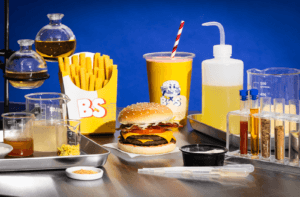
To expose exactly how fast food giants deliberately hook consumers, recipe box Gousto has created ‘The Big Secret’ – a dramatised and highly addictive burger meal that reveals what really lies behind some of the nation’s favourite fast foods.
The burger, which is not available to the public due to health concerns, initially appears as a familiar fast food meal – a bacon cheeseburger, fries, and a vanilla and strawberry milkshake. However, The Big Secret has been deliberately engineered to demonstrate how UK fast food is designed to drive cravings and overconsumption at the expense of long-term health.
It comes as UCL economists at Bloomsbury Policy Lab reveal the detrimental health outcomes linked to frequent fast food consumption. According to their findings, the risk of diet-related conditions such as obesity, diabetes, and cardiovascular diseases is greatly increased by the frequent consumption of fast food, and the UPFs it contains, and may be costing the British health system as much as £67 billion annually*.
Based on insights from RD Clare Thornton-Wood, ‘The Big Secret’, which contains 165% of the recommended daily intake of salt, over triple the daily sugar limit and extremely high levels of saturated fat, incorporates the very tactics fast food brands use to captivate the brain’s reward system. One of these is the ‘bliss point’ – the precise mix of sugar, salt, and fat that maximises pleasure while delaying fullness, sparking a dopamine response that naturally encourages repeat bites. Combining chemical enhancers and texture manipulation, the result is what could be considered the UK’s most addictive burger meal. It delivers over 2,100 calories in a form that can be eaten quickly and easily, with every component qualifying as ultra-processed, made up of 90 ingredients across the burger, fries and milkshake.
January is traditionally a time for New Year’s resolutions, yet new consumer research, commissioned by Gousto, shows just how difficult it is for Brits to resist addictive fast food. In December 2024, almost one-fifth (19%) of Brits committed to cooking from scratch and a further 22% planned to delete their delivery apps. A year on, in December 2025, a quarter (25%) of Brits made a New Years’ resolution to give up their fast food consumption, however by the end of the first weekend of 2026, nearly two-fifths (37%) had already given up.
The research revealed just how hard it is for consumers to make informed choices. Well over half (74%) of UK adults understand that high levels of fat, salt, and sugar are unhealthy, yet many suspect their favourite fast foods are worse than they realise (57%) – revealing a major knowledge gap that masks the true health risks hidden behind these meals. Adding to the issue, access to clear and digestible information remains a challenge, with almost half (46%) revealing they would not know where to look.
Clare explains how fast food companies engineer meals to override hunger cues and make moderation harder, commenting:
“When people struggle to cut back on fast food, it’s rarely about a lack of willpower. Many fast food meals are carefully engineered to stimulate the brain’s reward system, combining fats, salt, sugar and additives to hit the ‘bliss point’ and trigger dopamine responses that reinforce cravings rather than satisfy hunger.
“While these ingredients are approved for singular use, the way they’re layered together can make moderation much harder – particularly for those trying to eat more healthily. The challenge isn’t the individual, it’s the food environment they’re navigating.”
Through The Big Secret, Gousto is calling for clearer, more accessible ingredient information across the food industry, so consumers can truly understand what’s in the foods they buy and make healthier, more informed choices.
Timo Boldt, founder and CEO at Gousto said: “This isn’t about personal choice or willpower – it’s a broader systemic issue. The research exposes how ultra-convenient fast food is intentionally designed to keep us hooked, and the real cost this has on our health and the economy.
“We believe convenience shouldn’t come at the expense of health. That’s why we’re calling for more consistent, accessible information across the food industry, so people can better understand what’s really in the food they buy. By supporting clearer labelling and making cooking from scratch more accessible, we want to help households move away from a system that prioritises speed and profit over nutrition.”